Selecting the right lifting equipment can have a significant impact on productivity, safety, and workflow within a manufacturing or engineering facility. Two commonly considered options are the jib crane and the gantry crane. While both are effective lifting solutions, they serve different purposes depending on the layout of your workspace and the type of lifting tasks required.
Understanding the differences between these systems can help you determine which solution is best suited to your operation.
What Is a Jib Crane?
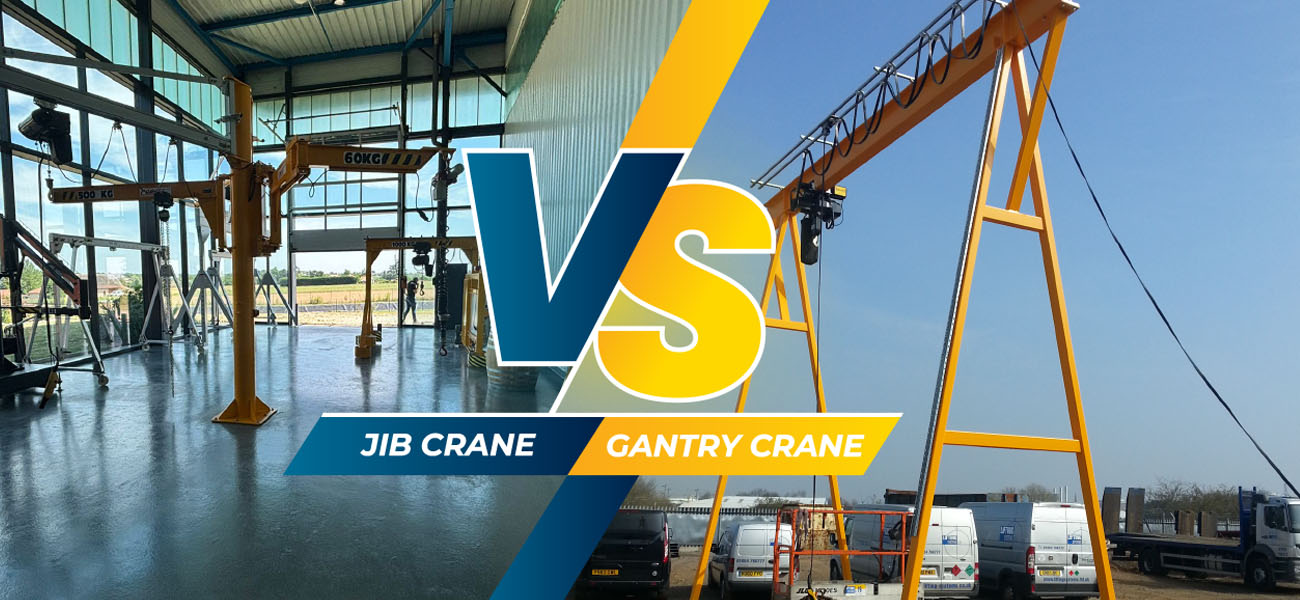
A jib crane is a compact lifting system designed to handle loads within a defined circular or semi-circular area. It typically consists of a horizontal arm (known as the jib) that supports a hoist and trolley, mounted to either a column or a wall.
Jib cranes are commonly used for workstation lifting tasks, such as:
- Loading and unloading machines
- Handling components on production lines
- Assisting with assembly operations
- Supporting maintenance activities
Because they operate within a fixed working radius, jib cranes are particularly effective in areas where lifting tasks occur repeatedly in the same location.
For facilities looking to improve efficiency at specific workstations, installing a jib crane can significantly reduce manual handling while speeding up routine operations.
When a Gantry Crane May Be the Better Choice
A gantry crane operates differently from a jib crane. Instead of being fixed in one position, gantry cranes are typically supported by legs that move along wheels or rails, allowing the crane to travel across the floor.
This makes gantry cranes well suited to applications where flexibility and mobility are required.
Typical uses include:
- Moving loads across different areas of a workshop
- Lifting equipment in facilities where overhead crane installation is not possible
- Supporting maintenance tasks across multiple workstations
- Temporary lifting operations during installations or shutdowns
For many manufacturing environments, a motorised gantry crane provides an effective solution when lifting tasks need to occur in multiple locations.
Fixed Coverage vs Flexible Lifting
When comparing a jib crane vs gantry crane, the key difference lies in how and where lifting takes place.
A jib crane provides dedicated lifting coverage for a specific workstation. Once installed, it offers fast and reliable lifting exactly where it is needed.
A gantry crane, on the other hand, offers greater flexibility. Because it can be moved around the facility, it can support multiple lifting areas without requiring permanent installation.
In some facilities, both systems may even work together — with jib cranes supporting production workstations while gantry cranes provide additional lifting capacity for maintenance or irregular lifting tasks.
Choosing the Right Lifting Solution
Every facility has different lifting requirements, and selecting the right equipment depends on several factors, including:
- Available floor space
- Frequency of lifting tasks
- Load capacity requirements
- Whether lifting needs to occur in fixed or multiple locations
An experienced lifting specialist can help assess your operational needs and recommend the most suitable solution.
Key Differences Between Jib Cranes and Gantry Cranes
| Feature | Jib Crane | Gantry Crane |
|---|---|---|
| Installation | Fixed to floor or wall | Mobile or rail-mounted |
| Coverage Area | Localised workstation | Larger working area |
| Mobility | Stationary | Moveable across floor |
| Ideal Use | Repetitive lifting tasks | Flexible lifting across facility |
At Lifting Systems, we supply and install a wide range of lifting equipment, including jib cranes, overhead cranes, and motorised gantry cranes, helping facilities across the UK improve safety and efficiency in their lifting operations.
If you’re considering a jib crane or gantry crane for your facility, our team can help you identify the most effective lifting solution for your application.
Frequently Asked Questions
What is the main difference between a jib crane and a gantry crane?
A jib crane is a fixed lifting system designed to operate within a defined circular or semi-circular working area, typically supporting workstation lifting tasks. A gantry crane, on the other hand, is a mobile system supported by legs that allow it to move across the floor, making it suitable for lifting tasks that need to take place in multiple areas.
When should you use a jib crane?
A jib crane is ideal when lifting tasks occur regularly in the same location. They are commonly used for machine loading, assembly operations, and workstation material handling where quick, repetitive lifting is required.
What are the benefits of a gantry crane?
Gantry cranes offer greater flexibility because they can move across a facility. They are particularly useful in workshops where overhead crane installation is not possible or where lifting needs change depending on the task.
Can a jib crane and gantry crane be used together?
Yes. Many facilities use a combination of lifting systems. Jib cranes can support fixed workstations while gantry cranes provide additional lifting capacity for maintenance tasks or areas where lifting needs to move around the facility.