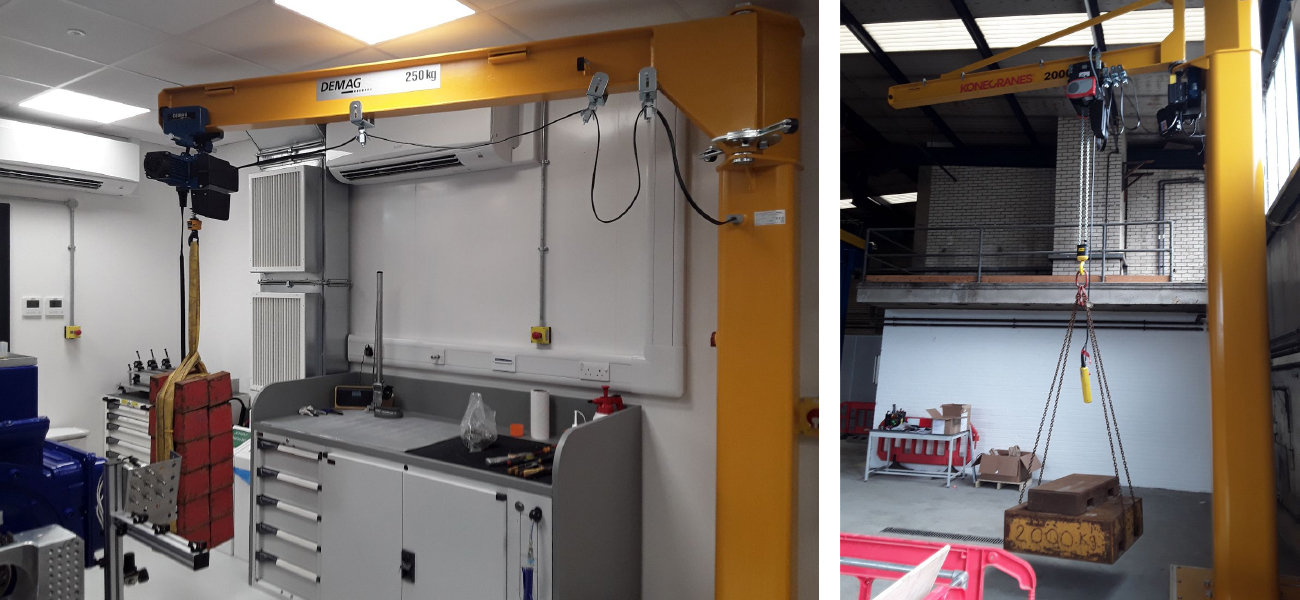
Jib cranes handle light-to-medium loads (50kg–10,000kg+) in spaces too tight for a full overhead crane. Available wall-mounted (up to 180° rotation) or floor-mounted on a pillar (up to 300°), they’re common across manufacturing, warehousing and construction. Lifting Systems designs, installs and maintains jib cranes UK-wide, with a free site survey to match the right configuration to your space. |
Table of Contents
In the bustling world of industrial operations, where every inch of space matters, the unassuming yet powerful UK-manufactured Jib Crane emerges as a silent hero. This article sheds light on the efficiency, adaptability, and indispensable role of our Jib Cranes, particularly in handling light loads within confined spaces across manufacturing, warehousing, and construction environments.
Understanding Jib Cranes
Jib Cranes are designed for efficiency in handling light loads, making them the ideal choice for repetitive tasks in limited spaces. Available in both column or wall-mounted pillar configurations, these cranes offer lifting capacities ranging from 50 kg up to an impressive 10,000+kg, accompanied by a slewing range of up to 300 degrees.
Jib Crane Specifications: Capacity, Reach & Slewing Range
Specifications vary a fair bit depending on configuration, so it helps to know what’s actually driving the numbers before choosing one for your space:
- Capacity: from 50kg for light manual handling up to 10,000kg+ for heavier-duty column-mounted systems – stocked systems cover up to 2,000kg, with bespoke configurable systems available up to 10,000kg
- Slewing range: up to 300° on pillar (floor-mounted) jibs, up to 180° on wall-mounted jibs
- Mounting: floor-mounted via a resin-anchored pillar, or wall-mounted to an existing structural wall or column
- Hoist type: manual or electric, matched to load weight and frequency of use
- Reach: boom length is specified to your working radius, from a single workstation up to several metres
Getting these right for your space is exactly what our site survey covers – we assess the working envelope, headroom and structural fixing points before recommending a configuration.
Applications in Various Industries
These versatile cranes find their applications across diverse industrial settings, from manufacturing floors and warehouses to shipping yards and construction sites. The design flexibility of Jib Cranes allows for easy installation and operation, with options for electric or manual hoists. Operators can effortlessly lift, move, and position materials, enhancing overall workflow efficiency.
Industry Applications in More Detail
In practice, that versatility looks different depending on the setting:
- Manufacturing floors: positioned at individual workstations to cut manual handling and repetitive strain during assembly or machine loading
- Warehouses and distribution: used alongside packing benches and loading bays for quick, repeatable lifts within a fixed radius
- Shipping yards and ports: wall or column-mounted jibs supplement larger cranes for smaller, more frequent lifts
- Construction sites: temporary or semi-permanent installations for material handling in areas too tight for mobile plant
Because each jib crane is specified to the job, the same core design adapts across all of these without needing a bespoke structure.
Manoeuvrability in Tight Spaces
Jib cranes provide controlled lifting within a defined working radius, making them particularly effective where floor space or access is limited. Depending on the configuration, wall-mounted systems offer up to 180° rotation while pillar-mounted systems can offer up to 300°.
Customisation for Unique Needs
Recognising that each operation is unique, Jib Cranes can be customised to specific requirements. Whether it’s column or wall-mounted pillar configurations, the adaptability of Jib Cranes ensures a tailored solution for your distinct needs.
Safety as a Priority
Safety is paramount, and Jib Cranes are equipped with limit switches and overload protection mechanisms. Regular maintenance and servicing are essential to ensure optimal performance. Lifting Systems offers an aftermarket service, providing assistance in maintaining the crane’s reliability over time.
Jib Cranes vs Other Lifting Solutions for Tight Spaces
Jib cranes aren’t the only option for confined-space lifting, so it’s worth knowing where they fit against the alternatives:
- Jib cranes: best for a single fixed working radius – one workstation, one bay, one loading point – where 50kg–10,000kg+ capacity and a compact footprint matter most
- Light crane systems: better suited where loads need to travel further than a jib’s radius allows, along a production line or between multiple workstations, while keeping a lightweight, modular structure
- Overhead cranes: the right choice once loads or spans exceed what a jib or light crane system can handle, covering a full bay rather than a fixed point.
If you’re not sure which fits your space, our engineers can talk through the trade-offs as part of a free site visit.
Choosing the Right Fit: Key Considerations
Selecting the right Jib Crane for your operations involves careful consideration. Questions such as the weight of the load, frequency of use, distance of movement, indoor or outdoor use, lifting height, hook coverage, building obstructions, and extremity dimensions are crucial. Our dedicated team at Lifting Systems will visit your premises, engaging in a thorough discussion to understand your needs. We provide expert advice and top-quality solutions tailored to your specific requirements, ensuring a seamless and efficient fit for your operations.
In conclusion, Jib Cranes stand as versatile workhorses, quietly optimising operations in limited spaces. Their adaptability, safety features, and customisation options make them an indispensable asset in the industrial landscape. For those navigating the complexities of material handling, Jib Cranes prove to be not just a solution but a strategic investment in efficiency and space optimisation. Find our more about Jib Cranes
FAQS
What's the maximum load a jib crane can lift?
Our jib cranes cover a 50kg to 10,000kg+ range, depending on configuration. Stocked systems cover up to 2,000kg; bespoke, configurable systems – including a 10 tonne power slewing pillar jib crane – extend up to 10,000kg. Column-mounted pillar jibs generally handle the heavier end of that range; wall-mounted jibs suit lighter, more frequent lifts.
What's the difference between a wall-mounted and a pillar jib crane?
Wall-mounted jibs fix directly to an existing structural wall or column and rotate up to 180° – a good fit where floor space is limited. Pillar (floor-mounted) jibs stand on their own resin-anchored base and rotate up to 300°, giving wider coverage where you have the floor space to install one.
Can a jib crane be installed in an existing building?
Yes, in most cases. Wall-mounted jibs need a structural wall or column capable of taking the load; pillar jibs need floor space and adequate slab depth for anchoring. Our site survey confirms what’s feasible before we quote.
How much space does a jib crane need?
A jib crane serves a defined working radius around one mounting point, making it particularly suitable for individual workstations or localised lifting. A light crane system provides greater travel between workstations or across a wider working area. Boom length is specified to your actual working area.
Do jib cranes need regular inspection?
Yes. As lifting equipment, jib cranes fall under LOLER and should be thoroughly examined at the required interval, alongside routine maintenance to keep limit switches, hoists and slewing mechanisms working correctly.
Lifting Systems has been manufacturing and installing crane systems across the UK since 1994. If you need a jib crane specified for a tight space, or want to compare it against a light crane system or overhead crane, contact our team for expert advice. |