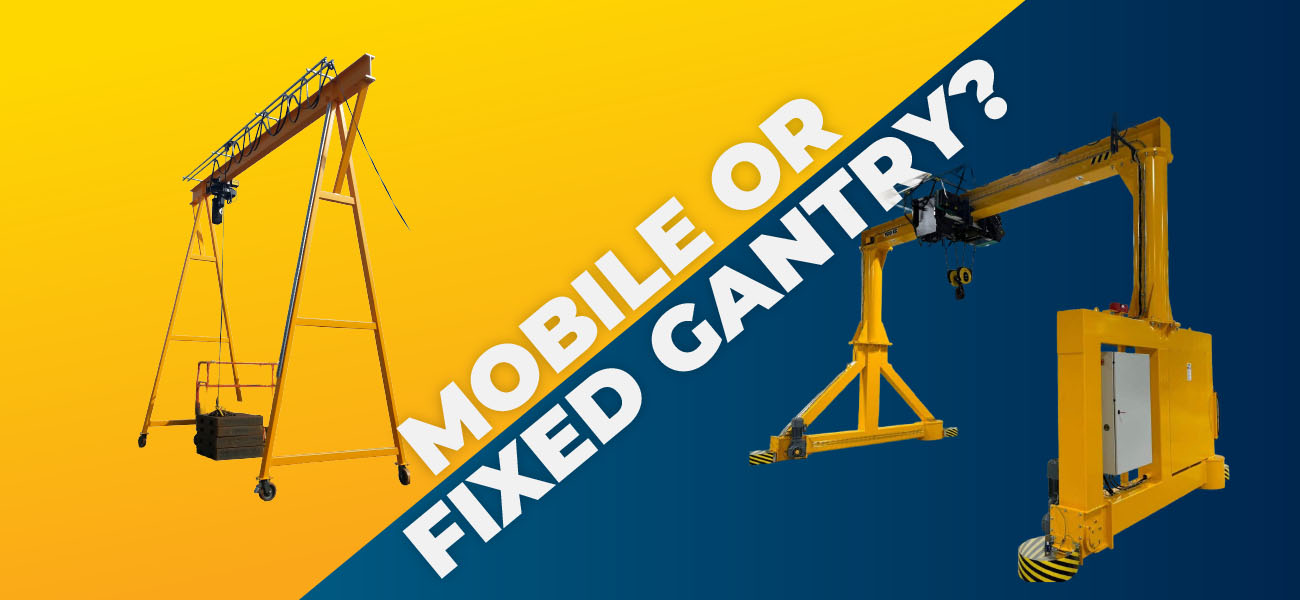
A mobile gantry crane and a fixed gantry system can both provide reliable lifting support, but they suit very different working environments.
A mobile gantry provides a flexible lifting point that can be repositioned where required. A fixed gantry forms part of the permanent lifting infrastructure, providing consistent coverage within a defined area.
The right choice depends largely on how and where lifting takes place within your facility.
What is a mobile gantry crane?
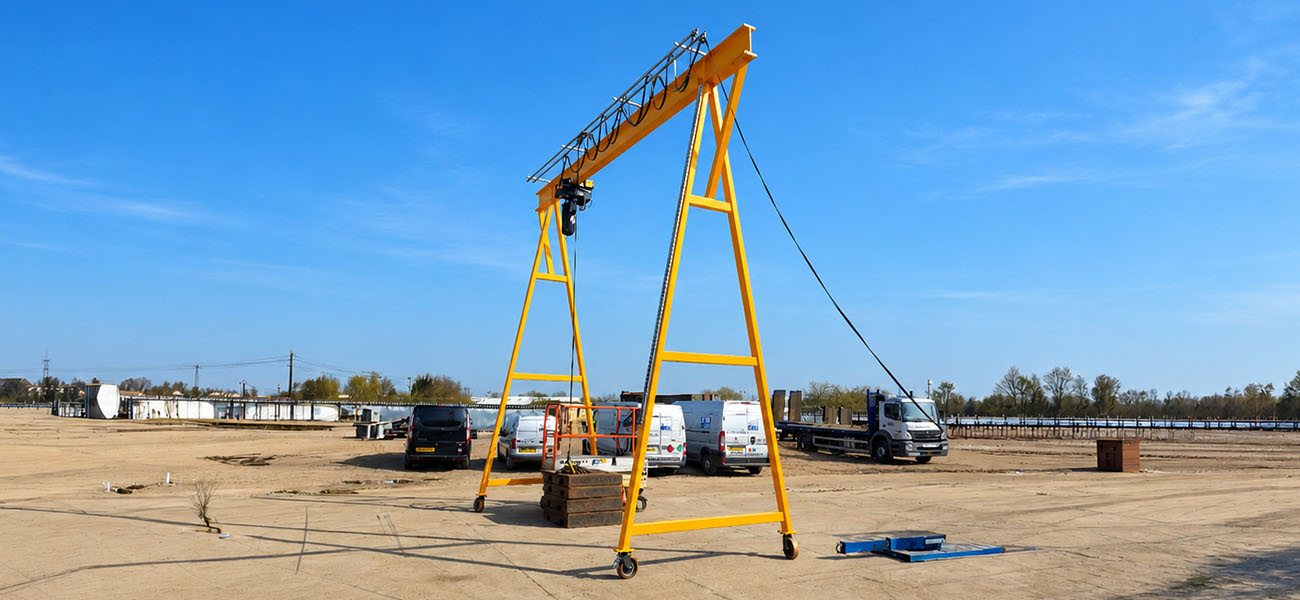
A mobile gantry crane is a freestanding lifting structure designed to be repositioned within a suitable working environment.
It typically consists of a horizontal beam supported by legs at either end, with a hoist suspended from the beam. Depending on the configuration, a trolley may also allow the hoist to travel along the beam.
This makes mobile gantries particularly useful where:
- lifting is required in different locations;
- maintenance or installation work takes place across a facility;
- permanent crane infrastructure is unavailable or unnecessary;
- lifting is occasional rather than continuous.
Lifting Systems designs and manufactures A-frame gantries for applications ranging from 50 kg to 5,000 kg.
If you are unfamiliar with this type of crane, see our guide to A-Frame Gantry Cranes: What They Are, How They Work and When to Use One.
What is a fixed gantry crane?
A fixed gantry system is permanently installed to provide lifting coverage within a defined area.
Rather than moving the lifting structure to the task, the system is designed around the way loads move through the operation.
Fixed gantries may support overhead travelling cranes and are commonly used where lifting is frequent, predictable or forms part of the production process.
For an example of a permanent heavy-duty installation, see our Poundfield 30-tonne lattice gantry project.
What is the main difference between mobile and fixed gantries?
The simplest distinction is this:
A mobile gantry brings the lifting equipment to the task.
A fixed gantry creates permanent lifting infrastructure around the task.
That difference affects how each system is used day to day.
A mobile gantry is generally better suited to changing lifting locations, maintenance work and occasional lifting.
A fixed gantry is generally better suited to repetitive lifting, wider coverage and operations where crane access is required throughout the working day.
When does a mobile gantry work best?
Mobile gantries work particularly well where flexibility matters more than permanent coverage.
Typical applications include:
- maintenance and repair work;
- machinery installation or removal;
- engineering workshops;
- temporary lifting points;
- occasional assembly tasks;
- areas outside existing crane coverage.
The ability to reposition the gantry means one lifting solution may support several working areas.
However, the movement route and floor conditions still need to be suitable.
What floor conditions are required?
A mobile gantry needs a safe and suitable surface on which it can be positioned and, where applicable, moved.
Floor condition, level changes, obstructions, thresholds, surrounding machinery and available clearance can all affect whether the system is practical.
This is particularly important in congested workshops or production environments.
It should also never be assumed that a mobile gantry can be moved while carrying a suspended load. Whether movement under load is permitted depends on the specific design and manufacturer’s operating instructions.
When is a fixed gantry more suitable?
A fixed gantry is generally more appropriate where lifting is frequent, predictable and central to the operation.
This may include facilities where:
- loads follow the same route repeatedly;
- crane access is needed throughout each shift;
- wider permanent coverage is required;
- heavier-duty lifting is involved;
- the lifting system forms part of the production layout.
Because the system is permanently installed, it can be designed around the workflow and provide consistent crane coverage without repositioning the structure between tasks.
Mobile vs fixed gantry: quick comparison
| Requirement | Mobile gantry | Fixed gantry |
|---|---|---|
| Lifting location changes | Well suited | Less relevant |
| Occasional lifting | Strong application | May be more infrastructure than required |
| Maintenance work | Strong application | Useful where permanent coverage exists |
| Repetitive production lifting | Less practical if frequently repositioned | Strong application |
| Permanent coverage | Limited to gantry position and span | Designed for defined working area |
| Flexibility | High | Lower, but more consistent |
| Permanent infrastructure | Limited | Required |
Can a facility use both?
Yes.
A permanent crane system may support the main production process, while a mobile A-frame gantry provides additional lifting capability for maintenance, installation work or areas outside the main crane coverage.
For larger facilities with varied lifting requirements, a combination of both can sometimes be the most practical approach.
Which option is right for your facility?
Start by considering how the crane will actually be used.
Ask:
- Does the lifting point need to move?
- Is lifting occasional or part of every shift?
- Do loads need to travel across a larger working area?
- Is there sufficient floor space to reposition a mobile gantry?
- Would permanent crane coverage improve the workflow?
The answers will usually indicate whether flexibility or permanent infrastructure should be the priority.
Choosing between mobile and fixed gantry cranes
A mobile gantry offers flexible lifting support where the lifting point changes or permanent crane infrastructure is unnecessary.
A fixed gantry is better suited to repetitive lifting, defined workflows and operations that require consistent crane coverage.
Lifting Systems designs and manufactures lifting solutions for a wide range of industrial applications, from mobile A-frame gantries to permanent gantry structures and overhead crane systems.
FAQs
What is the difference between a mobile and fixed gantry crane?
A mobile gantry can be repositioned within a suitable working area, while a fixed gantry is permanently installed to provide lifting coverage in a defined location.
Can you move a mobile gantry while it is carrying a load?
Not necessarily. This depends on the specific design and manufacturer’s operating instructions and should never be assumed.
Are mobile gantries suitable for maintenance work?
Yes. They are particularly useful where lifting is required in different locations or where permanent crane coverage is unavailable.
When is a fixed gantry more suitable?
A fixed gantry is generally more suitable where lifting is frequent, repetitive and concentrated within a defined working area.
Can a facility use both mobile and fixed gantries?
Yes. A fixed crane may support regular production while a mobile gantry provides flexible lifting support elsewhere.