When lifting is required but a permanent overhead crane system is not practical, an A-frame gantry crane can provide a flexible alternative.
These freestanding lifting systems are commonly used in workshops, maintenance areas, manufacturing facilities and other industrial environments where lifting is needed in a defined area without installing permanent runway steelwork.
So what exactly is an A-frame gantry crane, how does it work, and when is it the right option?
What is an A-frame gantry crane?
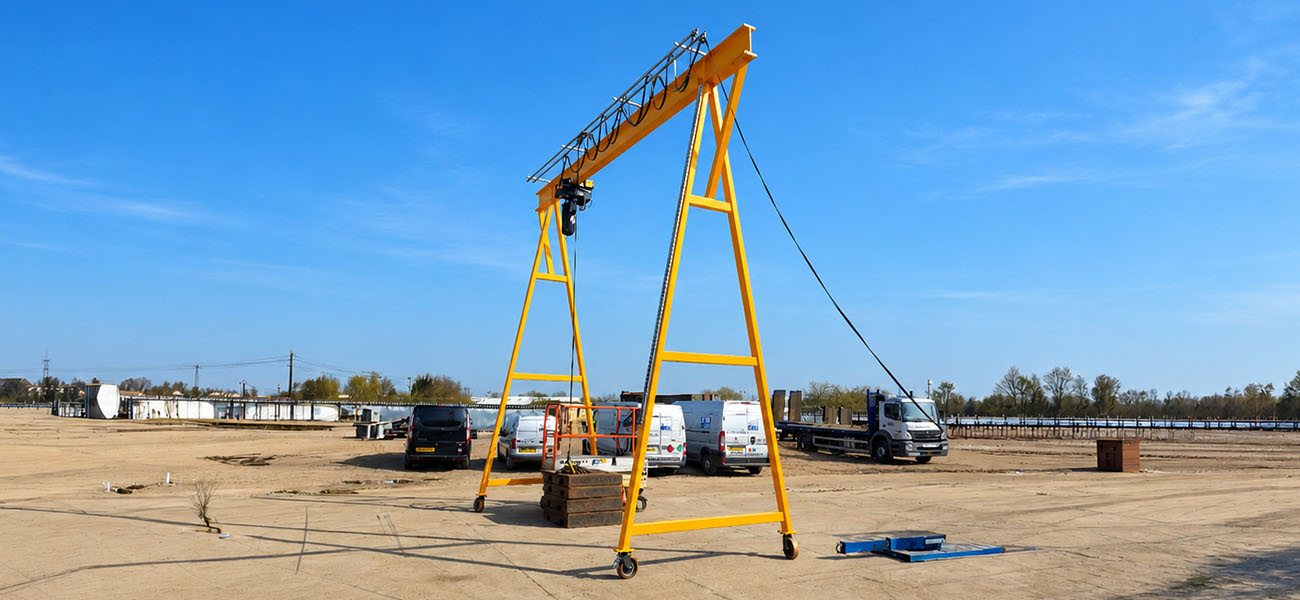
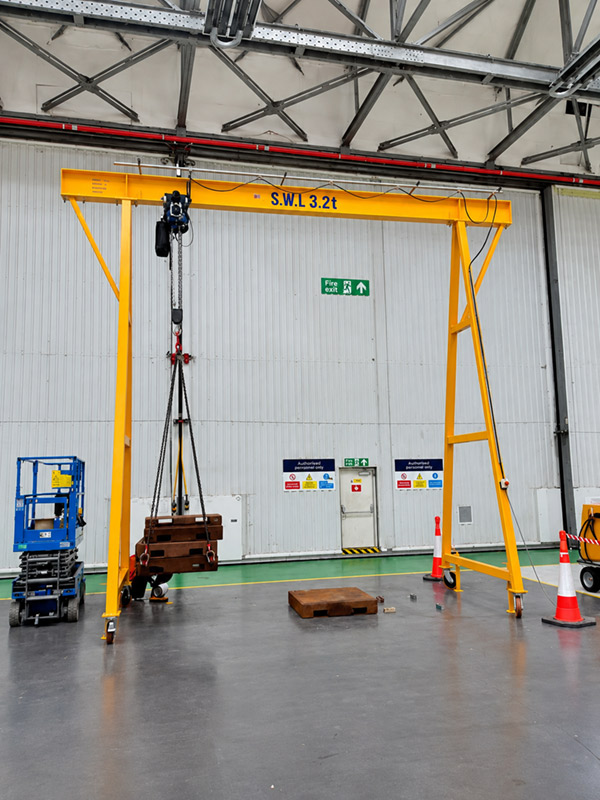
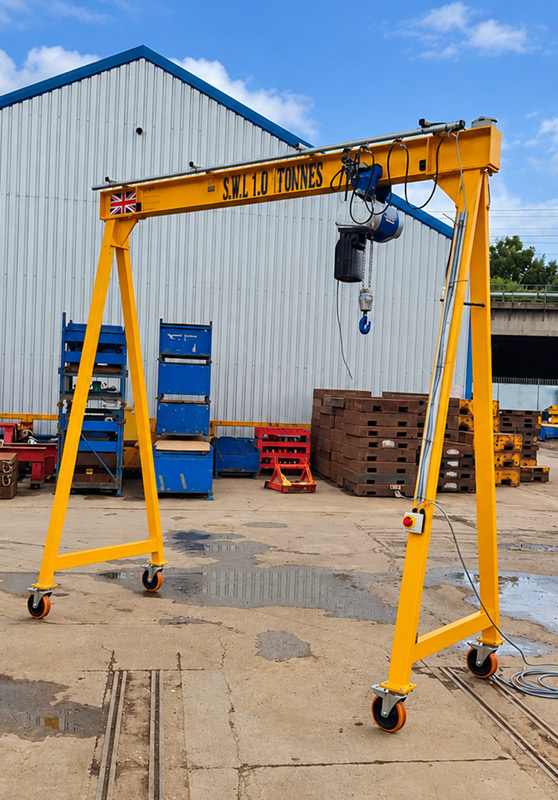
An A-frame gantry crane is a freestanding lifting structure made up of a horizontal beam supported by legs at either end.
A hoist is suspended from the beam and may be mounted on a trolley, allowing the load to be lifted vertically and moved horizontally along the span.
The supporting legs give the structure its characteristic A-frame shape.
Unlike an overhead travelling crane, an A-frame gantry does not normally rely on permanent runway beams or the existing building structure for support. This makes it useful in areas where fixed crane infrastructure is unavailable, impractical or simply unnecessary.
Lifting Systems designs and manufactures A-frame gantries to suit specific applications, with capacities ranging from 50 kg to 5,000 kg.
The basic principle is straightforward.
The A-frame structure supports the main beam, while the hoist raises and lowers the load. Where a trolley is fitted, the hoist can also travel along the beam, allowing the load to be repositioned across the width of the gantry.
Depending on the design, the gantry itself may also be capable of being repositioned within the working area.
This means an A-frame gantry can provide lifting capability without the need for a permanent crane runway.
The exact configuration will depend on the application, including the required capacity, span, lifting height, available space and how the crane will be used.
Where are A-frame gantry cranes commonly used?
A-frame gantries are particularly useful where lifting needs are localised, occasional or spread across different areas of a facility.
Typical applications include:
- lifting motors, machinery and components during maintenance;
- positioning equipment during installation or removal;
- supporting assembly and engineering work;
- handling loads in workshops without existing crane infrastructure;
- lifting components during repair or refurbishment;
- creating a temporary or localised lifting point;
- supporting maintenance activities in different parts of a site.
They can be especially useful in facilities where installing a full overhead crane system would be disproportionate to the lifting requirement.
Why use an A-frame gantry crane?
The main benefit of an A-frame gantry is flexibility.
Because the crane is supported by its own structure, it can provide lifting capability independently of the building itself.
This can make it suitable for:
Areas without crane runway steelwork
Not every building is designed to accommodate an overhead crane.
An A-frame gantry can provide a practical lifting option without relying on existing roof or runway structures.
Maintenance and repair work
Maintenance lifting often happens in specific areas and may not justify a permanent crane installation.
An A-frame gantry can provide targeted lifting support for machinery removal, component changes and repair work.
Changing lifting requirements
Where lifting points vary over time, a mobile or repositionable gantry can offer more flexibility than a permanently installed crane.
Installation work
A-frame gantries can also be useful when machinery or equipment needs to be lifted into position during installation, especially where no permanent crane system is available.
When is an A-frame gantry crane a good choice?
An A-frame gantry may be worth considering when:
- you need lifting capability without installing a permanent crane runway;
- lifting is required in a specific or changing area;
- your building is unsuitable for an overhead crane;
- lifting is occasional rather than continuous;
- maintenance or installation work requires a temporary lifting solution;
- the equipment needs to be positioned in different parts of a facility;
- your lifting requirement falls within the suitable capacity range.
The important point is that an A-frame gantry should suit the way the load actually needs to be handled.
It is not simply a question of whether the crane can lift the weight. The working area, movement required, frequency of use and available space all influence whether it is the right solution.
When might an A-frame gantry not be the right option?
A-frame gantries are versatile, but they are not suitable for every lifting application.
If loads need to be moved frequently across a large production area, a permanent overhead travelling crane may provide better coverage.
Similarly, very high lifting capacities, intensive production cycles or complex material-handling requirements may call for a more permanent crane system.
Floor space is another factor.
Because an A-frame gantry is supported from ground level, the legs and wheels or feet occupy space within the working area. This needs to be considered carefully in busy production environments.
What should be considered before specifying an A-frame gantry?
Before choosing an A-frame gantry, the lifting requirement should be assessed in context.
Key considerations include:
- maximum load weight;
- required span;
- lifting height;
- available headroom;
- floor condition;
- surrounding machinery or obstructions;
- how often the gantry will be used;
- whether the gantry needs to be repositioned.
Rather than selecting a crane based on capacity alone, these factors should be looked at together to determine whether an A-frame gantry is suitable for the application.
For broader guidance on selecting lifting equipment, see our article on how to choose the right industrial crane system for your facility.
Mobile or fixed gantry?
A-frame gantries can be designed for different working environments, including applications where mobility is important.
The right configuration depends on how frequently the lifting point needs to change, how the floor is constructed, the required capacity and how the equipment will be used.
We explore this in more detail in our guide:
Mobile vs Fixed Gantry Cranes: Which Is Right for Your Facility?
Do A-frame gantry cranes need to be inspected?
Like other lifting equipment used in the workplace, A-frame gantries need to be properly maintained and inspected.
The requirements will depend on the equipment, its use and the applicable UK lifting regulations.
Businesses should ensure that lifting equipment is suitable for the task, maintained correctly and subjected to the appropriate thorough examinations where required.
Lifting Systems can support customers with ongoing crane servicing, maintenance and LOLER requirements alongside the design and manufacture of lifting equipment.
Choosing the right A-frame gantry crane
An A-frame gantry can provide a practical lifting solution where flexibility is needed and permanent crane infrastructure is not.
Its freestanding design makes it particularly useful for maintenance, installation, workshop and localised lifting applications.
The right system, however, needs to be designed around the load, working area and way the equipment will be used.
Lifting Systems designs and manufactures A-frame gantry cranes tailored to individual applications, with capacities ranging from 50 kg to 5,000 kg.
Learn more about our A-Frame Gantry Cranes or contact the team to discuss your lifting requirements.
FAQs
What is an A-frame gantry crane?
An A-frame gantry crane is a freestanding lifting system consisting of a horizontal beam supported by legs at either end. A hoist is used to raise and lower loads, while a trolley may allow the hoist to travel along the beam.
What is an A-frame gantry crane used for?
A-frame gantries are commonly used for maintenance, machinery installation, repair work, assembly and other localised lifting tasks where permanent crane infrastructure is not available or required.
Can an A-frame gantry crane be moved?
Some A-frame gantries are designed to be mobile or repositionable. Whether this is appropriate depends on the crane capacity, floor condition, dimensions and intended application.
What weight can an A-frame gantry crane lift?
Capacity depends on the design and application. Lifting Systems supplies A-frame gantries with capacities ranging from 50 kg to 5,000 kg.
What is the difference between an A-frame gantry and an overhead crane?
An A-frame gantry is supported by its own legs, whereas an overhead crane normally travels on permanent runway beams installed within or supported by the building structure.
Is an A-frame gantry suitable for regular production use?
It can be, depending on the application. However, operations requiring frequent lifting across a large working area may be better suited to a permanent overhead or fixed gantry crane system.