Efficient material handling plays an important role in keeping manufacturing and production environments moving. While larger overhead cranes are ideal for heavier loads and broader lifting requirements, not every task requires a large-scale crane system.
For lighter loads, repetitive lifting tasks and workstation-level material handling, light crane systems can provide a practical and flexible alternative.
Designed for loads ranging from approximately 50 kg to 2,000 kg, light crane systems allow operators to lift, move and position components with smooth, controlled movement. They are particularly well suited to environments where materials need to be handled frequently within a defined production area.
So, where do light crane systems work best?
Assembly Lines and Production Cells
Assembly environments often involve the repeated movement of parts, tools or components between workstations.
Where operators are regularly lifting or repositioning materials by hand, a light crane system can provide dedicated lifting support directly above the working area. Instead of relying on manual handling or moving larger lifting equipment into position, loads can be lifted and transferred as part of the normal production process.
This can be particularly useful where components need to move through several stages of assembly or where accurate positioning is important.
Because light crane systems can be designed around the dimensions and workflow of the area, they can become part of the production process rather than an additional piece of equipment that needs to be brought in when required.
Individual Manufacturing Workstations
Some of the most demanding lifting tasks within a facility take place over relatively small distances.
An operator may repeatedly need to lift a component from a pallet onto a bench, move a part into a fixture or position equipment for machining or assembly.
Although individual loads may not be especially heavy compared with those handled by an overhead crane, the frequency of these movements can make manual handling inefficient.
A workstation light crane system provides localised lifting coverage where it is needed most.
This allows businesses to design lifting support around specific tasks rather than selecting one crane system based only on the largest load handled elsewhere in the facility.
Machine Loading and Unloading
Loading components into machinery can require both lifting capability and accurate positioning.
Whether feeding components into CNC machinery, production equipment or other industrial processes, operators may need to repeatedly move loads between storage areas, work surfaces and machines.
Light crane systems can help support these movements by allowing loads to be lifted, transferred and positioned in a controlled manner.
Their relatively lightweight construction and smooth push-and-pull travel can make them particularly suitable for applications where frequent movements and precise positioning are required.
Fabrication and Engineering Workshops
Fabrication and engineering environments often contain a mixture of lifting requirements.
A larger overhead crane may be used to move heavy materials across the workshop, while individual workstations still require support for smaller components, tooling or assemblies.
This is where different lifting systems can work alongside one another.
A light crane system can provide dedicated coverage over a particular fabrication bay or workstation without requiring the facility’s main crane to be used for every smaller lifting task.
This can help create a more practical material-handling setup by matching the lifting equipment to the specific task.
Packing, Inspection and Dispatch Areas
Material handling does not stop once production is complete.
Finished components may still need to be lifted between benches, inspection stations, packaging areas, pallets or dispatch points.
In these environments, the loads may be relatively light but handled repeatedly throughout the working day.
Light crane systems can provide a practical way of supporting these repetitive movements, particularly where the same lifting route or working area is used consistently.
Maintenance and Repair Workshops
Maintenance departments often handle motors, components, tooling and equipment that can be awkward to lift or position manually.
A light crane system installed over a maintenance workstation can provide lifting assistance when equipment needs to be removed, inspected, repaired or repositioned.
This provides permanent lifting coverage within the working area without necessarily requiring a larger overhead crane system.
Facilities with Changing Production Requirements
Manufacturing environments do not always remain the same.
New equipment, different production lines and changes in manufacturing processes can alter how materials need to move through a facility.
Light crane systems can be particularly useful where businesses need a lifting arrangement designed around specific production zones or workstations.
The right system will depend on factors including the required lifting capacity, available headroom, working area, building structure and how loads need to move between different stages of production.
For this reason, the lifting requirement should always be assessed in the context of the wider workflow rather than simply selecting equipment based on load capacity.
Choosing the Right Light Crane System for Your Facility
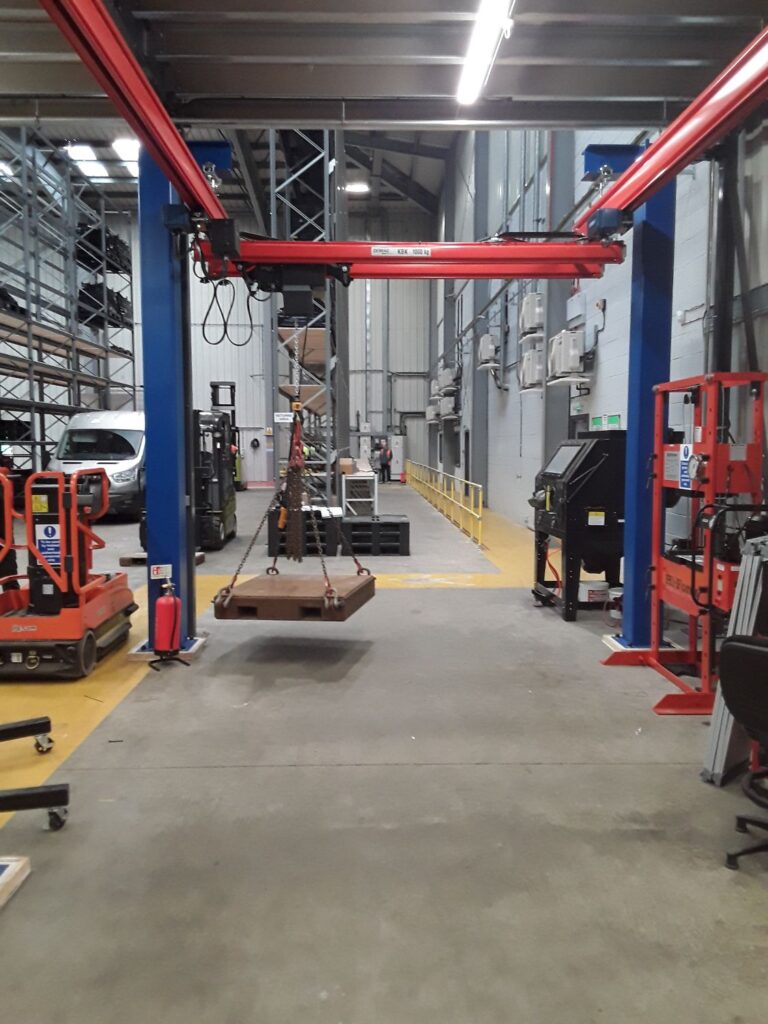
Light crane systems are most effective where lighter loads need to be moved frequently within a defined working area.
The right system will depend on factors such as load capacity, frequency of use, available headroom, required coverage and how materials move through the production process.
At Lifting Systems, we design and supply light crane systems for manufacturing, workshop and industrial environments, with capacities ranging from approximately 50 kg to 2,000 kg.
Explore our Light Crane Systems or speak to the Lifting Systems team about a lifting setup designed around your facility and production requirements.
FAQs
What are light crane systems used for?
Light crane systems are used to lift, move and position lighter loads within defined working areas. They are commonly used across manufacturing and production environments, including assembly lines, individual workstations, machine loading areas, fabrication workshops, packing stations and maintenance facilities.
What load capacities can light crane systems handle?
Light crane systems can typically be designed for loads from around 50 kg up to 2,000 kg, depending on the system and application. The correct lifting capacity should be determined by considering the load, frequency of use, required working area and wider production process.
Are light crane systems suitable for manufacturing workstations?
Yes. Light crane systems are particularly well suited to manufacturing workstations where operators need to lift or reposition components frequently within a relatively small area. They can provide dedicated lifting coverage directly around a workstation, production cell or assembly area.
Can a light crane system be used alongside an overhead crane?
Yes. Different crane systems can perform different roles within the same facility. An overhead crane may handle heavier loads across a large production area, while a light crane system provides localised lifting support for lighter and more repetitive tasks at individual workstations or production zones.
How do I know if a light crane system is right for my facility?
The most suitable lifting system depends on factors such as the weight of the loads, how frequently they are moved, the required coverage area, available headroom, building structure and how materials flow through the facility. A site assessment can help determine whether a light crane system or another type of lifting equipment is best suited to the application.
Can light crane systems be adapted to different production layouts?
Light crane systems can be designed around specific work areas and production requirements, making them suitable for many manufacturing environments where workflows or equipment layouts may evolve. The system should be specified according to the existing structure, lifting requirements and anticipated use.